November 19, 2026
How to Build a Multilingual GEO Strategy Across Markets

Most multilingual GEO strategies start in the wrong place. The same mistake companies have been making with international and multilingual SEO for years.
Companies take what they’re already doing in English, replicate it across languages, or simply track English-language prompts in non-English markets, assuming English is the default everywhere.
They collect AI-generated answers, build visibility dashboards, and assume they’ve developed an international strategy.
But a multilingual GEO strategy isn’t an English-language GEO strategy replicated across markets. And it certainly isn’t a list of translated prompts.
Building multilingual AI visibility requires understanding how your brand competes in each market, how customers discover and evaluate solutions, and what prevents your brand from entering relevant AI-generated recommendations.
This is where international SEO and growth experience become particularly valuable.
Working across markets means dealing with differences in search behavior, language, competitors, customer expectations, product positioning, and brand awareness. Those differences have always shaped international growth strategies. AI-assisted discovery adds another environment in which they matter.
And yet, multilingual GEO is frequently treated as though managing a global AI visibility dashboard were the same as understanding international markets.
It isn’t.
You can’t build a credible multilingual GEO strategy without international and multilingual expertise. You need people who understand globalization, localization, and international growth, who can challenge assumptions carried over from English-speaking markets and work with local specialists when necessary.
My methodology builds on years of working across markets. I start with the business and its competitive position in each country, not with an AI visibility dashboard. I investigate how potential customers research and compare solutions, where competitors have an advantage, and whether the company’s absence from AI recommendations reflects an information gap, a credibility gap, or a more fundamental market-fit problem.
From there, I connect the findings to specific interventions, involving international SEO, localization, brand marketing, PR, product, and regional teams where appropriate.
The methodology follows three principles: diagnose before optimizing, prioritize markets by commercial opportunity, and assign solutions to the teams best equipped to deliver them.
The objective isn’t to increase AI mentions across as many languages as possible. It’s to strengthen the company’s position in commercially relevant AI-assisted buying conversations.
Here’s how that translates into a multilingual GEO strategy that businesses can actually execute.
Table of Contents
What is a multilingual GEO strategy?
A multilingual GEO strategy is a market-specific approach to improving brand visibility and consideration in AI-generated answers across languages and countries. It combines local buying-intent research, competitive AI visibility analysis, international SEO, brand development, and cross-functional execution.
Unlike a translation-led approach, it prioritizes markets according to commercial opportunity and addresses the factors limiting brand recommendations in each one.
To understand how it works, it’s worth distinguishing between AI search, AI visibility, and GEO.
AI search is the environment in which customers discover and evaluate brands through tools such as ChatGPT, Gemini, Google AI Overviews, and AI Mode. Each works differently, but they all introduce opportunities for brands to be discovered beyond traditional search results.
AI visibility is the outcome: whether your brand appears in those answers, how it’s presented, and whether it’s cited as a source or recommended as a potential solution.
I use the term GEO because it has become part of the vocabulary businesses use to describe AI search optimization. But I don’t consider it a standalone discipline with a universal set of tactics that can reliably produce AI-generated recommendations.
For me, multilingual GEO is best understood within a broader international AI visibility strategy. The objective isn’t simply to optimize content for AI systems. It’s to understand how a brand competes across markets, identify what may be limiting its visibility and consideration, and determine which interventions are commercially justified.
But GEO is not the responsibility of one team alone.
International SEO specialists can manage the technical, search research, and content optimization work. Brand marketing, PR, localization, product, and regional teams contribute where the diagnosis identifies problems beyond SEO.
The overall strategy needs leadership from someone with international and multilingual growth expertise, capable of evaluating market differences, coordinating local specialists, and connecting the work to commercial objectives.
A company can have excellent international SEO and still struggle to appear in AI-generated recommendations in markets where it has limited recognition or credibility. That’s because AI visibility is fundamentally connected to brand reputation and market presence, with SEO supporting how information about the brand is made accessible, relevant, and discoverable.
A multilingual AI visibility strategy therefore needs to start with the brand’s competitive position in each market, not with a list of optimization tactics.
How to Build a Multilingual GEO Strategy: Diagnose, Decide, Execute
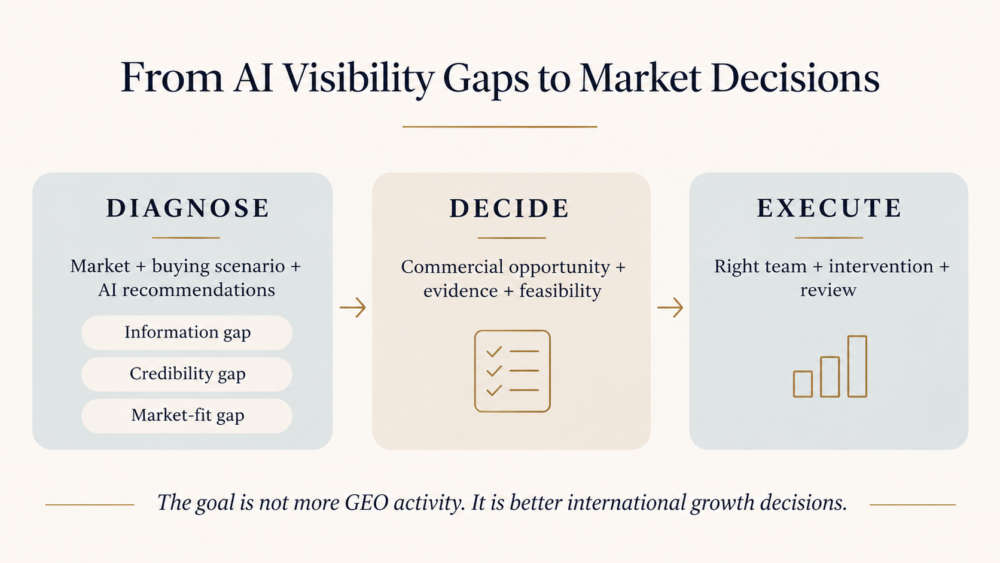
Building a multilingual GEO strategy requires three connected activities: diagnosing why a brand has limited AI visibility in specific markets, deciding which opportunities justify investment, and executing the appropriate interventions across SEO, brand marketing, localization, product, and regional growth teams.
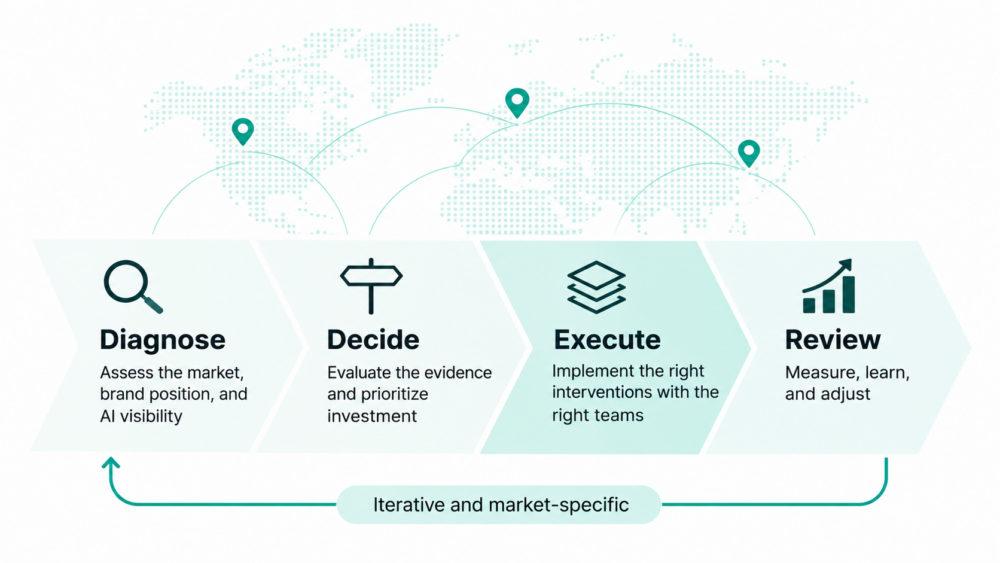
- Diagnose: Assess the brand’s competitive position, investigate local buying behavior, analyze AI-generated recommendations, and identify the evidence behind visibility gaps.
- Decide: Prioritize markets and opportunities based on commercial value, the strength of the diagnosis, and the feasibility of addressing the problem.
- Execute: Assign interventions to the teams best equipped to deliver them, coordinate implementation across markets, and evaluate results against the original objectives.
The framework is intentionally broader than SEO or AI optimization because the factors limiting a brand’s visibility may include weak market recognition, insufficient customer evidence, or poor product-market fit.
The objective isn’t to assign a GEO task to every visibility gap. It’s to identify what needs to change, why it matters commercially, and who should be responsible for making it happen.
The following stages translate that framework into a repeatable international growth process.
1. Assess market readiness and commercial opportunity
Before evaluating AI search visibility, the first step is establishing where the company is actually trying to grow and whether it has a credible opportunity to compete.
A multilingual website doesn’t necessarily represent an equally mature business presence in every country it serves.
A company might generate substantial revenue in France, have promising early adoption in Germany, and maintain an Italian website despite very limited customer traction.
Those markets shouldn’t automatically receive the same AI visibility investment.
My assessment starts with the commercial picture: revenue and growth potential, customer adoption, brand recognition, local competitors, product availability, and the company’s operational ability to support demand.
Brand strength is central to the assessment because AI visibility needs to be evaluated alongside the company’s competitive position in each market, not independently of it.
Is there branded search demand? Do customers recognize the company? Is it discussed in relevant industry publications or communities? Does it have regional customer evidence? What distinguishes it from established competitors?
These questions help establish whether weak AI visibility is occurring in an otherwise healthy market or alongside a broader lack of market traction.
A business with a strong local reputation but weak AI recommendations may have an addressable information or positioning problem. A relatively unknown business may first need to establish why customers should consider it at all.
Those are different starting points, even when the visibility dashboard shows the same result.
How to classify international GEO opportunities
Market opportunities can generally be grouped into three situations.
| Market position | What to investigate | Strategic implication |
|---|---|---|
| Established presence | Why a commercially credible brand may be underrepresented in AI-generated recommendations | Investigate gaps in information, positioning, and discoverability |
| Growing presence | Whether the brand has enough recognition, customer evidence, and product differentiation to compete | Combine GEO work with targeted market-specific brand building |
| Limited presence | Whether the business has established product-market fit and a viable competitive position | Validate the market before committing significant resources to GEO |
None of these situations are rigid categories; they’re simply a way to direct the investigation.
A company may be well established with enterprise customers but almost unknown to small businesses in the same country. The opportunity therefore needs to be assessed at the customer-segment level, not only at the country level.
And an emerging market isn’t automatically less attractive than an established one. Its long-term commercial potential may justify significant investment.
The question is whether that investment should go toward AI visibility, brand development, product positioning, or something more fundamental.
Low AI visibility alone is not a business case for spending more on GEO.
2. Map how customers discover and evaluate solutions in each market
Once the commercial priorities are established, the next step is investigating the buying situations in which AI search might influence customer consideration.
This work builds on international SEO research, but it doesn’t start with translating a keyword list into prompts.
Traditional search data is valuable because it reveals customer language, demand patterns, competitors, and the problems people are trying to solve.
However, an AI-assisted buying conversation may combine several needs that would otherwise appear as separate searches.
Someone might ask an AI assistant to recommend software for a small company, compare a shortlist, explain integration requirements, and assess whether a product is suitable for a particular country.
The underlying commercial decision is more important than the exact phrasing.
Start with the buying situation, not the prompt
Consider an international software company selling invoicing tools across Europe.
The buying criteria that matter in one market might not be identical to those in another. Local administrative requirements, established competitors, customer expectations, and available integrations can all influence how buyers evaluate a solution.
The research therefore needs to establish which requirements genuinely matter locally, rather than assuming that the same English-language questions represent equivalent buying behavior everywhere.
Use existing keyword research, customer and sales feedback, product documentation, regional knowledge, local industry discussions, and native-language input to identify those situations.
The result is a set of commercially relevant scenarios that can be investigated through AI search.
| Buying situation | What needs to be understood |
|---|---|
| Product discovery | Which solutions enter the customer’s initial consideration set? |
| Comparing alternatives | Which brands are recommended, and how are they differentiated? |
| Requirement validation | Is the brand presented as suitable for the buyer’s actual needs? |
| Switching providers | Which alternatives appear when a customer is dissatisfied with an existing solution? |
| Market-specific suitability | Is the product accurately represented in terms of local availability, functionality, and requirements? |
Only then do those scenarios become natural-language questions for the relevant AI platforms.
Some questions may be broadly equivalent across markets. Others will be specific to one country, customer segment, or purchasing context.
That’s intentional.
A multilingual GEO strategy should compare commercially equivalent needs, not force every market into identical English-language questions.
It’s also important to distinguish language from geography.
Running an English-language prompt with a French geographic setting doesn’t tell you how French-speaking customers experience AI search. And translating an English prompt into French doesn’t automatically establish that French customers would ask that question.
Both approaches may have a place in controlled research, but neither should substitute for validating actual local buying behavior.
If AI systems recommend different products across markets, the investigation needs to consider whether that difference reflects competition, product suitability, local information, the query language, or the AI system itself.
That requires more than a translated prompt dashboard.
3. Audit AI search visibility and competitive recommendations
The next stage is establishing how the brand currently appears in the AI-assisted buying scenarios identified during the research.
I examine the relevant platforms, the brands being recommended, and the way those brands are positioned.
But an AI visibility audit shouldn’t be limited to what AI systems say about a brand. It should also investigate whether those answers reflect the company’s actual position in the market.
A brand that’s well known, frequently considered, and supported by credible customer evidence may have advantages that aren’t explained by its organic rankings alone.
Conversely, a company can rank well and still lack the recognition or trust needed to compete with established local alternatives.
That’s why I analyze AI recommendations alongside brand awareness, market presence, and traditional search performance. Looking at AI visibility in isolation risks mistaking a brand problem for an optimization problem.
What an international AI visibility audit should examine
For each relevant market and buying scenario, the audit investigates:
- Which brands appear and which are absent.
- Whether the brand is recommended, mentioned, or cited.
- How products are differentiated and which buyer requirements influence the answer.
- Whether the information is accurate and appropriate for the market.
- Which accessible sources support the answer, when sources are provided.
I don’t consider a mention, citation, and recommendation equivalent.
A company may be cited as a source in an informational answer without appearing among the products a buyer should consider.
It may be recommended with inaccurate information about its features or availability.
Or it may appear consistently in comparisons but be framed as suitable for an audience that isn’t commercially relevant.
Those outcomes have different commercial implications.
A useful audit therefore needs to capture not just the frequency of appearances but the context and quality of those appearances.
It should also document the testing conditions.
AI-generated answers can vary by platform, language, geographic context, session, and repeated run. A single screenshot isn’t enough to support a meaningful international investment decision.
The objective is to identify recurring patterns, understand their limitations, and compare them with evidence from the wider market.
Use AI recommendations as competitive intelligence
One of the most useful outputs of this analysis is understanding how competitors are positioned in AI-assisted buying conversations.
Suppose a competitor repeatedly appears as the preferred choice for a particular customer segment.
The important question isn’t how to replace that competitor in the answer but why the recommendation appears plausible.
Does the competitor offer a capability the company lacks? Is it more widely recognized among the target audience? Does it have stronger independent customer evidence? Does the company have an equivalent offering but communicate it poorly?
Each possibility points toward a different response:
- If the product lacks a requirement buyers consider essential, the issue may belong to product strategy.
- If the capability already exists but is absent from localized information, international SEO and product marketing may be able to address it.
- If the competitor has stronger recognition and customer trust, the solution may require market-specific brand development.
The audit is valuable when it explains competitive differences and informs business decisions, not when it produces a larger list of prompts to monitor.
The deliverable at this stage is an evidence-based assessment of how the brand is represented, which competitors dominate relevant buying scenarios, and which gaps warrant further investigation.
4. Diagnose what’s actually limiting AI visibility
When a brand is missing from commercially relevant AI-generated answers, the next step is identifying the factors that may explain the gap.
This is where I distinguish three types of problems:
- Information gap: Relevant information is missing, inaccurate, inaccessible, or poorly represented in the sources AI systems can retrieve.
- Credibility gap: The company has limited market-specific recognition, customer validation, or independent evidence supporting its suitability.
- Market-fit gap: The product, positioning, pricing, availability, or capabilities may not adequately address the needs of the intended buyers.
These categories can overlap. They form a practical diagnostic framework, not a proven description of how AI systems select brands.
The distinction is crucial because each problem requires a different response.
Match the problem to the right intervention
| Diagnosis | Possible finding | Response | Primary contributors |
|---|---|---|---|
| Information gap | Relevant product features are missing from localized pages | Improve product information, discoverability, and content accuracy | SEO, localization, content, product marketing |
| Credibility gap | Local competitors have stronger customer evidence and industry presence | Build relevant customer proof, regional partnerships, and independent validation | Brand, PR, customer, regional teams |
| Market-fit gap | Buyers require functionality or conditions the product cannot provide | Reconsider positioning, audience, or product priorities | Product, commercial leadership, regional growth |
The framework establishes a boundary that I think is frequently missing from GEO discussions.
Discovering a problem through SEO or AI visibility research doesn’t make it an SEO problem.
International SEO specialists are well positioned to investigate demand, intent, competition, localization, and discoverability across markets. We can identify where a company is missing from relevant conversations and bring evidence into the discussion.
But solving the problem may require other specialists.
If a brand lacks credibility in a market, content optimization alone may have limited impact. If the company doesn’t meet a critical buyer requirement, additional citations won’t make the product more suitable.
For example, my role is to connect the findings to the appropriate people, help define the necessary work, and support execution where international SEO and multilingual expertise contribute. I don’t believe SEO should own every activity simply because it uncovered the issue.
The value comes from knowing which problems SEO can address, which require broader expertise, and how the different activities need to work together.
5. Turn the diagnosis into a market-specific decision
A diagnosis isn’t complete until it changes what the business decides to do.
For each meaningful visibility gap, I document the market, buying scenario, observed recommendation pattern, supporting evidence, likely explanation, and proposed intervention.
I also separate observations from assumptions.
If ChatGPT doesn’t recommend a company in a particular French-language comparison, that’s an observation.
It doesn’t establish that the company lacks credibility, that its SEO is weak, or that a competitor has more authority.
Those explanations need supporting evidence.
How to prioritize multilingual GEO opportunities
Not every identified gap should become a project.
I prioritize interventions according to four factors: commercial opportunity, competitive relevance, confidence in the diagnosis, and feasibility of execution:
- Commercial opportunity establishes whether improving consideration in that market and buying scenario could contribute meaningfully to the business.
- Competitive relevance establishes whether the gap affects decisions the company can realistically compete for.
- Confidence in the diagnosis reflects how strongly the available evidence supports the proposed explanation.
- Feasibility considers whether the required changes are achievable with the company’s resources, capabilities, and organizational constraints.
A significant recommendation gap in a commercially important market may deserve attention, but only if there’s enough evidence to justify an intervention and a realistic opportunity to improve the company’s position.
A smaller gap with clear supporting evidence and an achievable solution may be a better investment than a large visibility problem whose causes remain uncertain.
This prevents the strategy from becoming a list of everything the company could optimize.
| Stop collecting AI visibility data. Start making decisions. A missing recommendation doesn’t automatically mean you have an SEO problem. It could reflect limited local brand recognition, missing product information, weak market fit, or insufficient evidence. I’ve developed an 11-step International AI Visibility Framework & Checklist to help businesses investigate these possibilities before deciding where to invest. It covers market readiness, local brand strength, AI search observations, evidence requirements, common mistakes, and investment priorities. The resource also includes a free Google Sheets assessment workbook to document findings and turn them into actionable decisions across markets. Explore the International AI Visibility Framework & Checklist |
6. Apply the methodology: one visibility problem, two markets
Consider a US-based CRM company expanding into France and Germany. It has localized websites in both countries and discovers that its brand rarely appears in AI-generated recommendations for relevant customer segments.
The visibility issue appears similar. But its market positions are different.
In France, the company has an established customer base and a product that competes effectively with relevant alternatives. Its localized product information, however, doesn’t adequately communicate some of the integrations and capabilities valued by its target audience.
In Germany, the brand has limited recognition, few customers, and little independent evidence demonstrating its suitability for local businesses.
The findings lead to different working hypotheses.
| France | Germany | |
|---|---|---|
| Commercial position | Established customer base | Limited market traction |
| AI visibility observation | Rarely recommended | Rarely recommended |
| Primary hypothesis | Information or positioning gap | Credibility or market-fit gap |
| Next investigation | Review relevant localized information and recurring AI descriptions | Validate buyer needs, product fit, and brand recognition |
| Potential response | Improve content and product positioning | Coordinate product, brand, and market-development work |
| Teams | SEO, localization, product marketing | Regional growth, product, brand marketing |
In France, SEO and product marketing may have a relatively direct opportunity to improve how the product is represented.
In Germany, the company may need to establish why customers should consider the product in the first place.
The second problem cannot be solved simply by creating more localized comparison pages.
And the company may reasonably decide to prioritize France if the opportunity is commercially significant and the proposed improvements are supported by stronger evidence.
The objective isn’t to create a GEO task for every market. It’s to identify which investment is most likely to strengthen the company’s competitive position.
7. How to execute a multilingual GEO strategy across teams
Once the priority interventions are defined, they need to become an execution plan with clear ownership.
This is where international GEO becomes cross-functional.
Some activities belong to SEO. Others require localization, brand marketing, digital PR, product, customer teams, or regional growth.
The correct division of work depends on the diagnosis.
But before assigning activities, there’s a more fundamental question: who should be responsible for leading the strategy?
Who should lead a multilingual GEO strategy?
Knowing how to operate an AI visibility platform doesn’t mean knowing how customers research products in Italy, what drives purchasing decisions in Germany, or why a brand that’s established in the US struggles to gain recognition in Spain.
Those differences aren’t technical details to address after the strategy has been developed.
They should shape the strategy from the beginning.
Multilingual GEO needs leadership from people with experience in international SEO, globalization, localization, or international growth. Not because they should own every activity, but because they understand how to investigate market differences, challenge assumptions, and coordinate the specialists needed to address them.
Local knowledge remains essential. Even an experienced international strategist shouldn’t assume they understand every market without input from people who work in it.
The SEO team might lead the visibility investigation, but brand marketing, PR, product, and regional growth teams may need to own the resulting interventions.
Otherwise, you’re not building an international GEO strategy. You’re running an English-language strategy with international reporting.
This distinction is particularly important for companies operating across multiple countries, where a global strategy needs consistency without overriding local market realities.
What international SEO contributes to multilingual GEO
International SEO plays two important roles in a multilingual GEO strategy: understanding how customers search and evaluate solutions in different markets, and making sure the right information about a brand is available and discoverable.
The first is strategic. International SEO research helps identify differences in demand, search intent, competitors, and the language customers use to describe their needs.
Those insights are essential for multilingual GEO. They help establish which buying situations matter locally, what information potential customers expect, and where the brand may be losing visibility to competitors.
The second is about execution.
If a company offers a product in Germany but its German-language website doesn’t explain the features that matter to local buyers, that’s an information gap worth addressing.
International SEO can help identify those missing details, improve localized content, strengthen internal linking, and investigate technical issues that prevent relevant pages from being discovered.
Established SEO fundamentals still matter. Google’s guidance for AI search features confirms their relevance to AI Overviews and AI Mode. For multilingual websites, this includes making localized content accessible and implementing appropriate language and regional targeting.
But those improvements don’t guarantee that AI systems will recommend a brand.
International SEO can help a company become easier to find and understand. It cannot, on its own, make that company well-known, trusted, or competitive in a market.
That’s where brand marketing, PR, localization, product, and regional growth teams become essential.
The goal is to use international SEO where it contributes most, while recognizing when the problem requires a broader business response.
What brand, PR, localization, and regional teams contribute
When the diagnosis points toward brand recognition or credibility, which is very often the case, the work becomes broader.
That may mean developing market-specific customer evidence, working with reputable industry publications, building regional partnerships, or contributing to relevant professional communities.
These aren’t activities I’d pursue simply to obtain more AI citations.
They’re part of establishing a credible market presence.
Localization specialists contribute by ensuring the company’s messaging, information, and customer experience reflect how a market actually works, rather than reproducing assumptions from another country.
Product and commercial teams may need to address genuine barriers to adoption.
Regional teams can validate whether the strategy reflects real customer behavior and the competitive landscape.
I wouldn’t apply the same PR, partnership, or content distribution plan across every country. The sources customers use and the organizations they trust can differ significantly.
The overall strategy should be coordinated internationally, but the interventions must reflect the needs of each market.
That’s how the business maintains a coherent direction without treating every country as an extension of its English-language market.
8. Execute, review, and adjust the investment
A multilingual GEO strategy should result in a working process, not just a presentation or dashboard.
For each intervention, I define what is being changed, the hypothesis behind it, the people responsible, and what evidence would justify continuing, changing, or stopping the work.
The objective isn’t to promise a particular increase in AI citations within a fixed period.
Changes in AI-generated recommendations can be difficult to attribute. Brand-building activities may take considerably longer than technical content improvements, and different AI systems may respond differently.
A practical initial engagement can still establish meaningful deliverables.
What the first 90 days should produce
| Period | Focus | Deliverable |
|---|---|---|
| Days 1–30 | Market readiness, commercial priorities, locally validated buying scenarios, initial AI search investigation | Market opportunity assessment and AI visibility baseline |
| Days 31–60 | Competitive recommendation analysis, evidence review, gap diagnosis, stakeholder alignment | Market-specific diagnostic and prioritized decision backlog |
| Days 61–90 | Execute selected interventions, establish ownership, document changes, and review initial evidence | Implemented improvements, coordinated action plan, and next-quarter investment decisions |
These timeframes are illustrative and depend on business complexity and access to local expertise. The important deliverable is a set of justified decisions.
For example, a company might finish the assessment knowing that it should improve product information in France, investigate market fit in Italy, and deprioritize GEO investment in another market until the commercial opportunity is clearer.
That’s a useful strategic outcome even before AI recommendation rates change.
How to evaluate whether the strategy is working
Multilingual GEO performance shouldn’t be evaluated through brand mentions alone.
The assessment needs to consider whether the brand is becoming more visible in commercially relevant buying situations, whether AI-generated descriptions are accurate, and whether the business is strengthening its position in priority markets.
Those observations should be considered alongside brand awareness, search performance, customer acquisition, qualified demand, and revenue where relevant.
But correlation shouldn’t be confused with causation.
A customer may discover a company in an AI answer and convert through branded search. An increase in AI recommendations may coincide with a PR campaign without being caused by it.
The measurement methodology needs to account for those limitations, including how prompts are selected, how different languages and platforms are compared, and which outcomes can realistically be attributed to AI-assisted discovery.
For strategy execution, each review needs to answer a simpler question:
Did we learn enough from the intervention to support the next business decision?
If the findings don’t support the original diagnosis, the strategy should change.
If the work reveals a more fundamental problem with market positioning, the priorities should change.
And if a market offers limited commercial opportunity, the company should be willing to invest elsewhere.
A multilingual GEO strategy should improve international growth decisions
A multilingual GEO strategy isn’t successful because a company tracks more languages, publishes more localized content, or increases the number of AI answers mentioning its brand. Those activities may contribute to visibility, but they aren’t the commercial objective.
The value comes from understanding how a brand competes in different markets, where AI-assisted discovery creates opportunities, and what needs to change to make the company a credible option for potential customers.
Sometimes that requires better international SEO. Sometimes it means stronger localized product information, customer evidence, regional PR, or product improvements. And sometimes the right decision is not to invest further in GEO until the business has addressed a more fundamental market problem.
A strategy that tells you where not to invest can be more valuable than one that gives every market another optimization checklist.
So you need to investigate the problem, establish what matters commercially, and coordinate the right people to deliver the necessary changes.
Because multilingual AI visibility isn’t simply about making a brand visible in different languages. It’s about building a brand that’s relevant, credible, and worth considering in the markets where the company wants to grow.
That’s an international growth challenge before it becomes a GEO or SEO challenge.
Is your international AI visibility strategy solving the right problem? I work with companies expanding across markets, connecting international SEO, multilingual AI visibility, localization, and international growth strategy to commercial objectives. f your brand appears in AI-generated recommendations in some markets but struggles in others, let’s talk.
Keep reading
Related articles
The International AI Visibility Framework & Checklist — With Free Worksheet
Assess international AI visibility with a free Google sheet framework covering an 11-step framework.
Multilingual AI Visibility: What It Is and What It Isn’t
Why does your brand struggle in some markets? Discover how brand reputation, international SEO and multilingual GEO influence AI visibility.

Why SMB SEO Is Harder Than Enterprise SEO
Why is SMB SEO harder to than Enteprise SEO today? Explore search intent, content competition, AI visibility, and the challenge of turning traffic into revenue.