November 16, 2026
The International AI Visibility Framework & Checklist — With Free Worksheet
International AI visibility assessment is the process of evaluating how a brand appears, is described, and is recommended in AI-generated answers across countries and languages, and determining which market-specific factors may be affecting those outcomes.
A meaningful assessment goes beyond measuring mentions, citations, or recommendation frequency. It connects AI search visibility with local brand recognition, competitive positioning, customer buying behavior, product-market fit, and the information available about the business.
This matters because low AI visibility doesn’t automatically mean poor SEO or ineffective GEO. A brand can have excellent organic rankings and localized content but remain unfamiliar to customers in a particular market. It can also have an established local reputation while its product information is incomplete or inaccurately represented in AI-generated answers.
This International AI Visibility Framework & Checklist provides an 11-step assessment process to investigate these differences and answer six questions:
- Which countries, languages, customer segments, and AI search buying journeys represent meaningful commercial opportunities?
- How is the brand mentioned, recommended, cited, compared, or described across relevant AI platforms and local-language scenarios?
- How strong is the brand’s existing position in each market, including local recognition, independent credibility, customer adoption, and competitive relevance?
- Do the observed AI visibility gaps suggest missing information, limited brand credibility, product-market fit issues, or insufficient evidence to establish a likely explanation?
- Which interventions should be prioritized in each market, and should responsibility sit with international SEO, brand and PR, localization, product, or regional growth teams?
- How should those interventions be evaluated to determine whether to continue, expand, revise, or stop investment?
The framework follows a Diagnose → Decide → Execute methodology, supported by ongoing review. It combines international SEO and multilingual GEO analysis with local market research and brand assessment to turn AI visibility observations into evidence-based business decisions.
Its purpose is not to maximize AI visibility in every country or generate a universal GEO readiness score. It is to identify where improving AI visibility can support business growth, what may be limiting the brand’s position, and which investments are justified by the evidence.
The accompanying Google Sheets framework provides a structured way to document market assessments, AI search observations, working diagnoses, commercial priorities, and accountable actions.
The checklist below explains the 11 steps, the evidence required at each stage, the mistakes to avoid, and the expected outcomes.
Table of Contents
How the International AI Visibility Framework Works
The framework starts with a principle that is frequently overlooked in international AI search optimization: a visibility gap is not automatically an optimization opportunity.
A company may be absent from AI-generated recommendations because relevant information is incomplete or difficult to retrieve. But its competitive position may also be constrained by limited local brand recognition, insufficient independent credibility, or a product that doesn’t fully meet local buyer requirements.
These situations require different investigations, different teams, and different investments.
Rather than starting with AI search performance alone, the framework evaluates market readiness, local brand strength, buyer behavior, and the available evidence before recommending an intervention.
It follows three stages — Diagnose → Decide → Execute — supported by continuous review and learning.
| Stage | Purpose | Steps | Expected output |
|---|---|---|---|
| Diagnose | Establish market readiness, understand local buyers, observe AI visibility, and investigate potential gaps | 1–5 | A market-specific working diagnosis supported by evidence |
| Decide | Evaluate evidence quality and determine whether an intervention merits investment | 6–7 | A prioritized business decision with documented rationale |
| Execute | Match the intervention to the business problem and assign accountable teams | 8–9 | A market-specific action plan with clear ownership |
| Review and learn | Test the original hypothesis, evaluate outcomes, and adjust investment | 10–11 | An updated decision to continue, expand, revise, or stop |
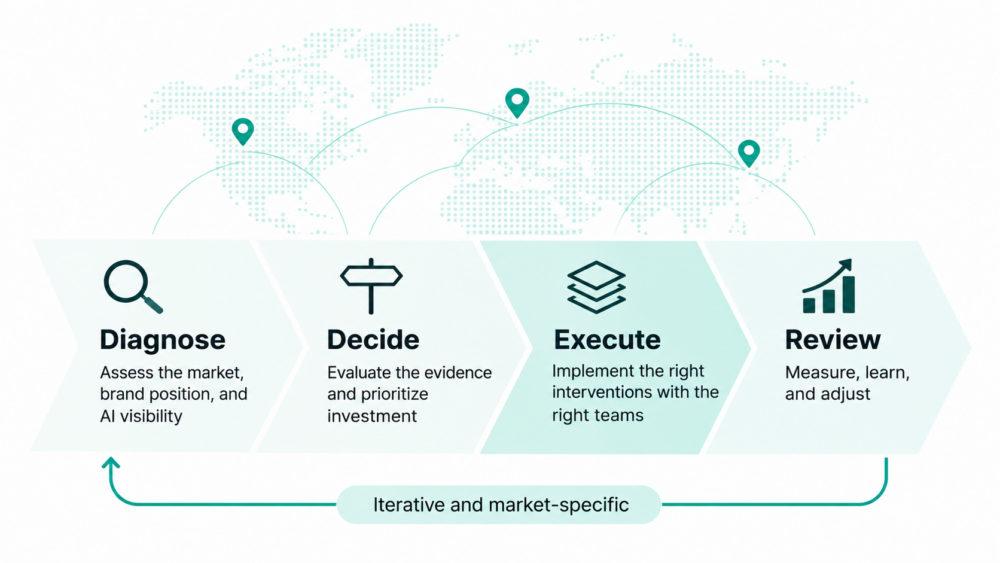
The process is iterative. New evidence may change the original diagnosis, and not every market needs to proceed to an optimization initiative.
The Three Types of International AI Visibility Gaps
The assessment uses three categories to organize the investigation:
| Gap | Definition | What to investigate |
|---|---|---|
| Information gap | Relevant brand or product information may be incomplete, inaccurate, inaccessible, or inadequately represented in a specific market | Localized product pages, documentation, feature descriptions, accessibility, and factual consistency |
| Credibility gap | The brand may lack sufficient independent recognition, reputation, or validation among target customers in the market | Customer adoption, reviews, local partnerships, industry coverage, and competitive brand recognition |
| Market-fit gap | The product, offer, or positioning may not adequately address important local customer needs or competitive requirements | Product suitability, pricing, local requirements, support, availability, and buyer expectations |
These categories are not mutually exclusive, and none can be established by an AI-generated answer alone.
A missing recommendation is an observation. The explanation remains a hypothesis until supporting evidence is available.
This distinction matters because SEO can contribute to improving information accessibility and discoverability, but it cannot independently establish local brand reputation or solve product-market fit problems.
The 11-Step International AI Visibility Checklist
This checklist covers the complete assessment process, from evaluating market readiness to choosing the right interventions and reviewing their results.
Each step includes the question to answer, practical actions, supporting evidence, mistakes to avoid, and the expected outcome.
The objective is to distinguish observed AI visibility patterns from their potential causes before making market-specific investment decisions.
Diagnose: Understand the market before optimizing
| Step | Key question | Actions to take | Evidence required | Mistakes to avoid | Expected outcome |
|---|---|---|---|---|---|
| 1. Establish market importance and readiness | Is improving AI visibility commercially worthwhile in this market? | Define target buyers, business opportunity, existing adoption, product availability, local requirements, and capacity to support demand. Compare the market against other growth priorities. | Market-specific revenue or adoption data, target customer research, product availability, local requirements, and documented commercial priorities. | Assuming every translated website deserves the same investment. Treating low AI visibility as evidence of commercial opportunity. | A documented market opportunity and readiness assessment. |
| 2. Assess local brand recognition and credibility | Does the brand have an established position among target buyers in this country? | Investigate local customers, branded demand, independent reviews, industry recognition, relevant partnerships, and competitor reputation. Separate market-specific evidence from global brand signals. | Local customer adoption, branded search trends, independent reviews, relevant media or industry references, and competitive brand evidence. Identify where recognition hasn’t been measured. | Treating English-language authority, organic rankings, or translated content as proof of local brand credibility. | A market-specific brand assessment identifying recognition, reputation, and evidence gaps. |
| 3. Validate local buying behavior | Are we assessing the questions and decisions customers actually make in this market? | Research local-language terminology, buying scenarios, customer requirements, comparison criteria, and relevant competitors. Validate assumptions through native-language research and regional expertise. | Native-language search research, customer interviews or feedback, local sales and support insights, relevant competitor comparisons, and documented buying scenarios. | Directly translating English prompts. Testing only English questions against non-English country settings. Assuming identical buying journeys across markets. | A validated set of local buying scenarios and commercially relevant questions. |
| 4. Establish an AI visibility baseline | Is the brand recommended, mentioned, cited, linked, or absent in relevant AI-generated answers? | Test representative scenarios on relevant AI platforms. Record prompts, language, platform, market conditions, dates, competitors, and response evidence. Repeat important tests under reasonably comparable conditions. | Saved AI responses, exact prompts, platforms, dates, language and location settings, relevant testing conditions, repeated observations, and recorded competitor appearances. | Treating one response as a stable ranking. Equating mentions, citations, and recommendations. Combining incomparable testing conditions into one visibility score. | A documented baseline showing observed AI visibility patterns by market and buying scenario. |
| 5. Investigate information, credibility, and market-fit gaps | What might explain the observed visibility pattern? | Examine localized product information, accessibility, factual accuracy, independent brand evidence, customer adoption, and product suitability. Identify evidence supporting and challenging each explanation. | Evidence for and against information, credibility, and market-fit hypotheses, including product documentation, independent market research, customer evidence, competitor positioning, and alternative explanations. | Assuming every gap is an SEO problem. Selecting a diagnosis because it’s the easiest intervention to execute. Confusing observations with proven causes. | A working diagnosis with supporting evidence, alternative explanations, and confidence level. |
Decide: Turn observations into investment decisions
| Step | Key question | Actions to take | Evidence required | Mistakes to avoid | Expected outcome |
|---|---|---|---|---|---|
| 6. Validate the evidence behind the diagnosis | Is there enough reliable evidence to justify an intervention? | Review repeated AI observations, independent market information, source quality, customer evidence, and competing explanations. Identify what remains unknown before recommending action. | Documented AI observations, independent corroborating evidence, source relevance and quality, competing hypotheses, and an explicit record of uncertainty or missing information. | Treating repeated AI answers as independent proof of causation. Assigning high confidence without independent validation. | An evidence review and a decision to act, investigate further, or reconsider the hypothesis. |
| 7. Prioritize commercially relevant opportunities | Is this the right problem, market, and moment to invest? | Evaluate commercial opportunity, competitive relevance, confidence in the diagnosis, and execution feasibility. Consider product readiness, market maturity, organizational capacity, and alternative investments. | Commercial opportunity data, relevant competitive context, documented diagnostic confidence, resource and implementation constraints, and the expected business contribution of the intervention. | Prioritizing the largest visibility gaps without considering business value. Assuming every market needs a GEO initiative. | A documented investment priority and rationale, including opportunities to defer. |
Execute: Match the intervention to the business problem
| Step | Key question | Actions to take | Evidence required | Mistakes to avoid | Expected outcome |
|---|---|---|---|---|---|
| 8. Select the appropriate intervention | What needs to change to address the identified problem? | Address validated information gaps through accurate localized product information and relevant SEO work. Address credibility gaps through genuine customer evidence, brand development, partnerships, or PR. Investigate market-fit gaps through product, positioning, or regional growth decisions. | A supported working diagnosis, documented business constraint, proposed intervention, rationale for the selected approach, and a specific observable change to evaluate. | Commissioning content when the underlying issue is limited market credibility or product suitability. Chasing AI citations without meaningful business value. | A specific intervention linked to a testable business hypothesis. |
| 9. Assign strategic leadership and local ownership | Who should make the decision, execute the work, and validate local assumptions? | Coordinate strategy through experienced international growth leadership. Assign execution to the relevant SEO, brand, product, PR, localization, or regional teams. Include local expertise where needed. | Named accountable decision owner, responsible functional team, supporting stakeholders, local reviewer, execution requirements, and agreed review criteria. | Allowing ownership to default to whoever operates the AI visibility platform. Applying an English-first strategy without local validation. | An accountable owner, supporting teams, local review responsibilities, and execution plan. |
Review: Evaluate outcomes and adjust investment
| Step | Key question | Actions to take | Evidence required | Mistakes to avoid | Expected outcome |
|---|---|---|---|---|---|
| 10. Review the original hypothesis | Did the intervention improve the condition it was intended to address? | Document implementation dates, repeat comparable AI observations, assess information accuracy and competitive patterns, and review relevant business indicators separately. Record platform or testing changes. | Original baseline, implementation records, comparable follow-up AI observations, relevant market or business indicators, and documented limitations affecting interpretation. | Measuring task completion instead of results. Assuming AI mentions caused revenue. Comparing different prompt samples as a stable trend. | A documented evaluation of the original hypothesis and observed changes. |
| 11. Decide what to continue, change, or stop | Which interventions and markets justify further investment? | Compare results with commercial priorities. Expand evidence-supported work, revise weak hypotheses, defer premature market investments, and identify foundational brand or product improvements. | Results from the review, current commercial priorities, remaining market constraints, available resources, and documented reasons for continuing, revising, expanding, or stopping investment. | Scaling programs solely because visibility scores remain low. Continuing activity after evidence contradicts the investment rationale. | An updated international investment plan with explicit continue, revise, expand, or stop decisions. |
How to use this checklist: Work through the stages in order, documenting what is known, what remains uncertain, and which decisions the available evidence supports.
Not every assessment should produce an optimization project. In some markets, the most valuable outcome will be identifying the need for stronger brand credibility, product improvements, or further research before investing in GEO.
How to Use the Free International AI Visibility Framework Worksheet
The article explains what to investigate and why. The workbook provides the working structure to record evidence, compare market assessments, evaluate competing hypotheses, and turn findings into accountable decisions—without building the system from scratch.
The checklist provides the assessment methodology. The accompanying Google Sheets framework helps put it into practice across multiple markets.
The template includes seven tabs:
| Worksheet | Purpose |
|---|---|
| Assessment Playbook | Follow the 11-step methodology, including questions, actions, evidence standards, and common mistakes |
| Start Here | Understand the workflow, decision guidance, and evidence requirements |
| Market Assessment | Evaluate commercial opportunity, local brand strength, product suitability, and market readiness |
| AI Evidence Log | Record AI-generated answers, local buying scenarios, competitors, and testing conditions |
| Decision Board | Investigate information, credibility, and market-fit hypotheses, assess evidence, and document decisions |
| Action Plan | Assign interventions, owners, review criteria, and follow-up decisions |
| Worked Example | See how similar AI visibility patterns can require different market decisions |
Start with one market, not your entire international portfolio
Choose a market with a meaningful commercial opportunity and a specific customer buying scenario.
Complete the Market Assessment first. Establish what is already known about the brand, its customers, competitors, and product suitability.
Then use the AI Evidence Log to record relevant observations and the Decision Board to investigate possible explanations.
Only after evaluating the available evidence should you prioritize interventions and assign ownership.
The worksheet includes guided inputs, assessment criteria, and decision signals to make the process more consistent.
It isn’t designed to predict AI recommendations or calculate a definitive GEO readiness score. The purpose is to distinguish evidence from assumptions and make investment decisions explicit.
Get the International AI Visibility Framework — Make Your Free Google Sheets Copy
Why the Same AI Visibility Gap Can Require Different Decisions
Consider a fictional CRM provider assessing its AI visibility in France and Germany.
The brand is rarely recommended in relevant AI-generated comparisons in either market.
At first glance, the visibility problem looks similar.
But the company has an established customer base in France and limited adoption in Germany.
| Assessment | France | Germany |
|---|---|---|
| Brand position | Established customer base | Limited local adoption |
| AI visibility | Rarely recommended in relevant comparisons | Rarely recommended in relevant comparisons |
| Independent evidence | Existing customers, but some localized product information may be incomplete | Limited customer references and independent validation |
| Working diagnosis | Possible information gap | Possible credibility or market-fit gap |
| Next investigation | Check localized feature accuracy, accessibility, and repeated AI observations | Research local customer requirements, brand consideration, and adoption barriers |
| Potential intervention | Improve accurate product information if the hypothesis is validated | Develop genuine regional evidence or reconsider positioning and product suitability |
| Likely leading teams | International SEO and product marketing | Regional growth, brand, and product |
This example is illustrative. Neither diagnosis is established by the AI outputs alone.
A conventional GEO program might recommend additional content optimization in both markets.
But that assumes the same intervention can address two potentially different business problems.
In France, the company might benefit from more complete and accurate information about its product.
In Germany, its priority might be establishing a stronger market position—or determining whether its product is competitive enough in the first place.
The same AI visibility outcome doesn’t necessarily imply the same problem or justify the same investment.
That’s why international AI visibility requires market-specific diagnosis rather than a global list of optimization tasks.
Example: From an AI Visibility Observation to a Business Decision
The France–Germany comparison shows why similar AI visibility patterns can require different strategic responses. But how does that assessment translate into an actual decision?
Consider the fictional CRM provider operating in France.
| Decision field | Assessment |
|---|---|
| Market and customer segment | France — small and medium-sized B2B sales teams |
| Buying scenario | Comparing CRM software for a 20-person sales team |
| Observed AI behavior | The brand is rarely recommended in the hypothetical French-language comparison tests |
| Independent market evidence | The company has an established French customer base, but some localized integration information may be incomplete |
| Working diagnosis | Possible information gap |
| Alternative explanations | Competitors may offer integrations better suited to French buyers. The AI observations may also be too limited to represent broader discovery patterns |
| Confidence level | Low — the information gap has not yet been independently validated |
| Commercial relevance | Potentially high, given the existing customer base and relevant buying scenario |
| Recommended next action | Verify localized integration information, compare product capabilities against competitors, and repeat relevant AI observations under documented conditions |
| Accountable teams | International SEO and product marketing, supported by French-market expertise |
| Decision | Investigate further before investing in a content or GEO initiative |
| Review criteria | Confirm whether the information gap exists and, if changes are implemented, evaluate product representation under comparable testing conditions |
This is a fictional example illustrating the framework, not an actual AI visibility experiment.
The distinction matters because identifying an AI visibility gap is not the same as identifying the investment required to address it.
In this case, publishing more content might eventually be appropriate. But until the evidence supports the information-gap hypothesis, the most valuable action is further investigation.
The framework therefore separates three decisions: what is happening, what might explain it, and whether the available evidence justifies intervention.
How to Interpret Your Assessment
The framework is intended to support decisions, not produce an artificial score suggesting that one market is 84% ready for AI visibility optimization.
A completed assessment should lead to one of three outcomes.
1. Proceed with a targeted intervention
There is a meaningful commercial opportunity, the brand or product is sufficiently ready, the evidence supports a plausible diagnosis, and an achievable intervention has been identified.
The next step is to define ownership, the expected change, and how the hypothesis will be reviewed.
2. Investigate further
The market may be commercially important, but the existing data doesn’t adequately establish what’s limiting the brand’s visibility.
Additional local customer research, competitive analysis, AI testing, or brand assessment may be more valuable than immediate optimization.
3. Reconsider or defer investment
The assessment reveals weak product-market fit, limited commercial opportunity, insufficient local capacity, or foundational brand challenges that an AI search optimization program is unlikely to resolve.
The appropriate investment may belong elsewhere.
A successful AI visibility assessment doesn’t always end with more GEO work. Sometimes it prevents a company from investing in the wrong problem.
Methodology and Limitations
The International AI Visibility Framework combines international market assessment, AI search observation, independent brand and competitive research, and commercial decision-making.
It is designed to help organizations evaluate evidence consistently across countries and languages, not to reverse-engineer how AI systems select brands for their answers.
What the framework evaluates
The assessment distinguishes four types of information:
| Evidence type | What it establishes |
|---|---|
| Observed AI behavior | Whether and how a brand appears in tested AI-generated answers under documented conditions |
| Independent market evidence | What is known about local brand recognition, customer adoption, product suitability, and competitive positioning |
| Working hypotheses | Plausible explanations for observed visibility patterns that require further validation |
| Business decisions | Whether an intervention is commercially justified, who should own it, and how its results should be evaluated |
This distinction matters because AI-generated answers can vary across platforms, prompts, languages, locations, sessions, and time.
A brand’s absence from an AI-generated response does not establish that its content is inaccessible, its reputation is weak, or its competitors have greater authority.
Similarly, an improvement observed after an intervention does not automatically demonstrate that the intervention caused it.
How to use the findings responsibly
For meaningful comparisons, document testing conditions and preserve reasonably consistent buying scenarios over time.
Where possible, corroborate AI observations with independent evidence, including customer information, competitive research, and local market expertise.
Separate confirmed facts from assumptions and document alternative explanations rather than treating one hypothesis as certain.
The worksheet’s assessment criteria and decision signals are practical decision-support tools. They are not scientifically validated prediction models, proprietary AI ranking factors, or guarantees of commercial outcomes.
The framework is most useful when it helps a business make a better investment decision, even when that decision is to investigate further or postpone optimization.
Supporting Resources and Documentation
The framework applies international SEO and market research principles to AI-assisted discovery while recognizing the limitations of observing AI-generated answers.
The following resources provide additional strategic and technical context:
| Resource | What it helps with |
|---|---|
| Multilingual AI Visibility: What It Is and What It Isn’t | Understanding the relationship between AI visibility, brand strength, and international SEO |
| Google Search Central: AI Features and Your Website | Understanding Google’s guidance for websites appearing in its AI search experiences |
| Google Search Central: Managing Multi-Regional and Multilingual Sites | Technical foundations for country- and language-targeted websites |
These sources can inform parts of the investigation. They do not establish that a specific intervention will produce recommendations in any particular AI system.
From AI Visibility Data to International Growth Decisions
AI visibility data can reveal whether a brand appears in relevant recommendations, how it is described, and which competitors are being surfaced.
It cannot independently tell a business why that is happening or where the next investment belongs.
A market might need more accurate and accessible information. Another might need stronger brand recognition, independent customer validation, or a more competitive product.
And some markets might not justify additional investment at all.
The International AI Visibility Framework & Checklist is designed to help businesses make those distinctions before committing resources.
Because international AI visibility isn’t about reproducing an English-language optimization program across more languages.
It’s about understanding where a brand can compete, what is limiting its position, and which decisions will help it grow.
Framework created by Veruska Anconitano, International SEO, AI Visibility & Global Growth Strategist. Version 1.0 · November 2026. Need help assessing AI visibility or developing an international growth strategy? Get in touch.
Keep reading
Related articles
Multilingual AI Visibility: What It Is and What It Isn’t
Why does your brand struggle in some markets? Discover how brand reputation, international SEO and multilingual GEO influence AI visibility.

Why SMB SEO Is Harder Than Enterprise SEO
Why is SMB SEO harder to than Enteprise SEO today? Explore search intent, content competition, AI visibility, and the challenge of turning traffic into revenue.

Why AI Visibility Depends on Brand Validation, Not Consensus
AI visibility is not built through repetition alone. Learn why brand validation, third-party evidence, and reputation are more important than manufactured consensus.