November 3, 2026
Multilingual AI Visibility: What It Is and What It Isn’t
Your company is an established name in the US. You have a recognizable brand, a healthy customer base, a strong organic presence, and plenty of third-party coverage.
You’re now expanding into Europe. Your website has been translated, your international SEO strategy is in place, and you’re starting to rank for relevant keywords in Germany, France, and Italy.
But when someone in those markets asks ChatGPT or another AI assistant to recommend a product in your category, your brand barely appears.
Why?
Because being an established brand in one market doesn’t automatically make you an established brand in another. And AI visibility, just like brand awareness, needs to be built market by market.
This is where the conversation around multilingual AI visibility often goes wrong.
Much of the advice focuses on translating content, implementing hreflang, and adapting GEO tactics across languages. Those are useful activities that need to stay and be budgeted for. But they don’t explain why a company with strong international SEO can still struggle to appear in AI-generated recommendations outside its home market.
Multilingual AI visibility isn’t simply about appearing in AI answers in different languages. It’s about whether your brand is relevant and credible enough to be considered in the markets you’re trying to reach.
International SEO has traditionally helped companies capture demand across markets. AI search adds another question: does your brand enter the consideration set when potential customers ask AI systems what they should buy or use?
And if the answer is no, the problem might not be your website. It might be your brand’s position in that market.
That’s the distinction companies need to understand before investing in another multilingual GEO strategy.
And that consideration set is influenced by much more than what’s published on your website.
Multilingual AI visibility should therefore be treated as an international brand-building challenge, with SEO as one of the disciplines supporting it.
The starting point isn’t another multilingual content calendar. It’s understanding how strong your brand actually is in each market, whether that strength is reflected in AI-generated answers, and what needs to change when it isn’t.
Table of Contents
What is multilingual AI visibility?
Multilingual AI visibility, also called multilingual AI search visibility, describes how consistently a brand appears in relevant AI-generated answers across different languages and markets, particularly when people are researching problems, comparing solutions, or making purchasing decisions.
It includes being mentioned in an answer, cited as a source, or recommended as a potential solution. These outcomes are related, but they aren’t equivalent.
An AI assistant might cite one of your articles when explaining a topic without ever recommending your company as a solution. But your product could appear in a shortlist of recommended tools without your website being cited.
For a business expanding internationally, the distinction is one of the most important things to consider. Getting cited for an informational question may be useful for discoverability, but appearing when someone is actively comparing products is a different commercial opportunity.
Multilingual GEO (Generative Engine Optimization) describes efforts to improve how brands and their information appear in AI-generated answers across languages and markets.
It’s closely connected to multilingual AI visibility, but there’s an important distinction: GEO describes the optimization work, while AI visibility describes the outcome.
And neither can be approached effectively without understanding the brand’s position in each market.
I’ve been arguing for a while that AI visibility is fundamentally connected to brand reputation, rather than simply being an SEO problem.
International expansion introduces another complication: brand reputation doesn’t travel uniformly across borders.
A company targeting Spain and Mexico is operating in two different competitive environments, even though both markets use Spanish. Customers may recognize different brands, consult different publications, and evaluate products against different alternatives.
The language is shared. The market isn’t.
If your company’s reputation varies by market, why would you expect its presence in AI-generated recommendations to be consistent across languages and countries?
Your global brand isn’t necessarily a local brand
A company may have excellent brand recognition in the United States and assume that its existing reputation will support growth elsewhere.
Sometimes it does. Certain brands have significant international recognition long before they formally enter a new market.
But this isn’t universal.
A software company familiar to US marketers might be almost unknown among Italian small businesses. A financial technology provider established in the UK may face entirely different competitors and trust requirements in Germany.
The underlying product hasn’t changed, but the company’s competitive position has.
Consider the information available about an established local competitor. It may have years of customer relationships, independent reviews, coverage from industry publications, partnerships, and ongoing discussions in relevant communities.
A company entering the same market could have a better product and a perfectly localized website but much less publicly available evidence of its suitability for local customers.
AI systems don’t simply reproduce human brand awareness, and a lesser-known company can certainly appear in AI-generated recommendations. Different AI products use different retrieval and generation mechanisms, and their answers depend on the question and context.
And the idea that AI-generated brand recommendations can differ across languages is no longer just a theoretical concern.
What research tells us about language and brand recognition
A June 2026 research preprint, The Language Blind Spot: How Query Language and Brand Recognition Tier Shape AI-Constructed Brand Reputation, examined 35,640 responses from three AI systems, covering 66 brands across 12 European languages.
The researchers found that switching from English to a brand’s home language had a much greater effect on recommendation share for locally established brands than for global multinationals.
They also found that the choice of language affected which brands appeared in recommendations more than it affected how those brands were described.
This is particularly relevant for companies using English-language prompts to monitor their international AI visibility.
An English-language audit will never give you a representative picture of which brands are being recommended when people research products in their own languages.
The study has limitations. It is a preprint, its brand sample is concentrated in specific European markets, and it doesn’t establish that local brand awareness caused the differences observed. But it provides a compelling reason to challenge the assumption that AI visibility measured in one language can be extrapolated to another.
A second June 2026 preprint, How Large Language Models Source Brand Reputation Across Languages and Markets, examined 167,551 URL-grounded citations across 128 brands.
The analysis found that 85.7% of those citations pointed to websites the brands didn’t own.
That doesn’t tell us whether those sources caused a particular brand to be recommended. It also shouldn’t be generalized to every AI system or every type of purchasing question.
What it demonstrates is that, in the retrieval settings studied, information about brands frequently came from outside their own websites.
For international companies, that raises a question worth asking: if your brand has very little presence in the independent sources relevant to a particular market, what information is available to support its credibility there?
That’s not an argument for manufacturing mentions. It’s an argument for understanding the wider information environment in which your brand competes.
A multilingual website makes your company accessible across languages. It doesn’t automatically give your brand an equally substantial footprint in every market.
Why translation isn’t enough for multilingual AI visibility
If you’re expanding internationally, translation is essential.
Customers need to understand your product. They need information in a language they’re comfortable using. Search engines and AI systems benefit from accessible, relevant content.
There is evidence that language availability can influence AI citations.
In a study examining approximately 1.3 million citations across Google AI Overviews and ChatGPT, Weglot and Ellipsis found that translated websites achieved greater citation visibility in several of the comparisons studied. One reported comparison showed a 327% advantage for translated websites in Google AI Overviews for queries in languages the untranslated websites did not serve.
It’s an interesting finding, although it doesn’t establish that translation alone caused the difference or that individual websites should expect comparable results.
More importantly, citation visibility isn’t the same as brand consideration.
Translation makes information available. Localization makes that information more appropriate for a particular audience. But neither automatically makes a company relevant, credible, or competitive in a market.
Imagine you’re a B2B software company expanding into Italy. You’ve translated your product pages, localized your pricing, implemented hreflang correctly, and published Italian versions of your most successful English-language articles.
Yet local competitors have established customer relationships, recognizable partners, and case studies demonstrating how their products solve problems for Italian businesses.
Your content may be accessible, but you haven’t necessarily given buyers a convincing reason to choose your company over those alternatives.
More translated content could improve organic coverage. It might even contribute to AI citations. It won’t automatically solve the underlying brand problem.
On top of this there’s a persistent issue when entering a new market: companies tend to translate what they already have without establishing whether it addresses the actual needs of the target market.
But when an AI assistant is asked to compare solutions, the question isn’t simply whether your website contains an answer. It’s whether there’s enough relevant information to justify including your company among the options.
And sometimes the missing information isn’t another article. It’s evidence of product fit, customer adoption, or local credibility.
A website can be perfectly localized and still represent a brand that has very little presence in the market.
Where international SEO and multilingual GEO fit
The term international GEO is increasingly used to describe strategies for improving AI search visibility across countries and languages.
I understand why the terminology exists, but I wouldn’t treat it as an entirely separate international growth discipline.
When properly planned and executed, International SEO already provides the infrastructure and market understanding companies need. It helps identify how demand differs across countries, which topics matter, how customers describe their problems, and what information needs to be accessible. It also deals with the technical foundations of multilingual websites, including language targeting, URL structures, indexing, and discoverability.
Google’s guidance for AI search features reinforces the continued relevance of established SEO practices for Google AI Overviews and AI Mode.
But SEO is one part of a broader system.
Brand awareness develops through product adoption, marketing, PR, partnerships, customer experience, communities, and repeated exposure.
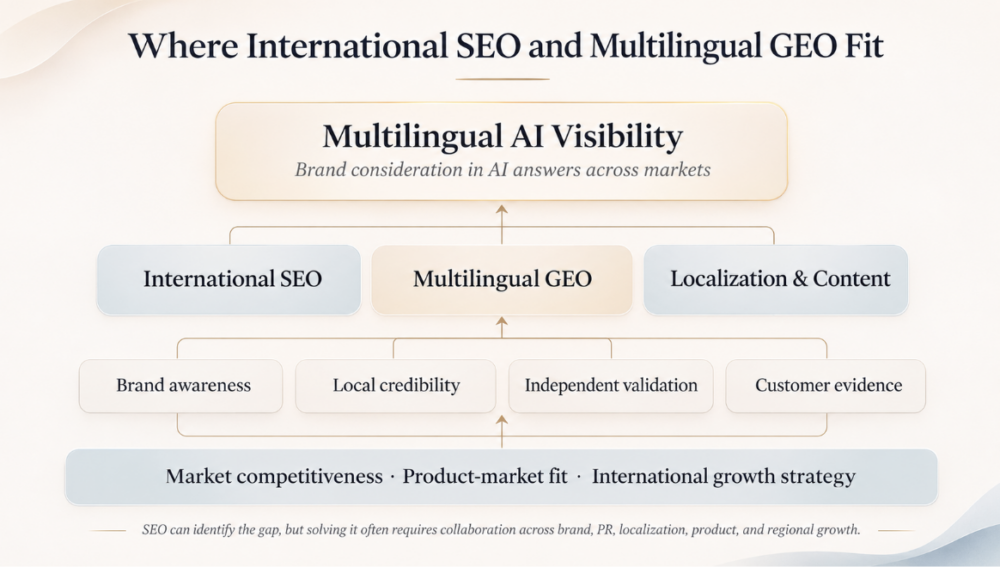
For international companies, those activities need to reflect the reality of each market.
A PR strategy that establishes credibility in the US may not reach the publications that matter to buyers in France. A product message that resonates in the UK may need to be reconsidered in Germany because competitors, product requirements, and purchasing conditions differ.
This is where I think international SEO specialists have an interesting opportunity. We’re already accustomed to investigating differences in demand, language, intent, competition, and market behavior. We can use that experience to identify where a company lacks visibility and where the problem extends beyond search.
But identifying the problem doesn’t mean we should own every part of the solution. Our role is also to bring those findings to the right teams, whether that’s brand marketing, PR, localization, product, or regional growth, and support them in addressing the gaps.
The value isn’t in trying to make SEO responsible for everything. It’s in knowing where SEO can contribute, where other expertise is needed, and how to connect the work.
The distinction between what SEO can explain and what requires a broader investigation is particularly important when evaluating AI visibility.
My own analysis of Google AI visibility and organic ranking data offers a useful example of why these distinctions matter.
I examined Google Search Console data from a large travel website, comparing organic performance with visibility in Google’s generative search experiences. Strong organic performance was associated with AI visibility, but the relationship wasn’t linear. Some pages with relatively modest average organic positions received substantial AI visibility.
More interestingly, AI visibility was concentrated around the product and topic for which the company had its clearest brand association and external reputation.
That was an observation within one website’s dataset, not proof that brand reputation caused the result. It also doesn’t establish how ChatGPT or other AI assistants select recommendations.
But it reinforces a question I think international growth teams should be asking: when a company performs differently across discovery environments, how much of that difference can search optimization explain, and how much requires investigating its broader brand position?
The answer will vary by company and market. And that’s precisely why I don’t assume that every multilingual GEO problem needs another SEO solution.
When poor AI visibility is an international growth problem
This is where, to me, the conversation has practical consequences.
Imagine an international SaaS company evaluating expansion performance in France and Italy.
In France, it has a growing customer base, reasonable brand recognition, and strong organic visibility. Yet the company rarely appears in AI-generated comparisons for an important customer segment.
In Italy, it’s almost unknown, has limited customer adoption, and faces established competitors. Its AI visibility is similarly weak.
Both markets have an AI visibility problem on paper.
But I wouldn’t automatically recommend the same investment.
In France, there may be a gap between the company’s existing market position and how its products are represented in AI-generated answers. Perhaps important product information is difficult to discover. Perhaps its differentiation isn’t clear in French-language sources. Or perhaps the tracked questions don’t reflect the scenarios in which the company is genuinely competitive.
In Italy, the issue may start much earlier. The business may need to develop its reputation, strengthen its product-market fit, or establish a meaningful customer base before investing heavily in AI-specific visibility work.
Identifying demand for a category isn’t the same as establishing demand for your particular product and this principle applies also to AI-assisted discovery the principle
Just because people in a country ask AI assistants for recommendations in your category doesn’t mean your brand has a credible claim to be among them.
The expensive mistake is treating every absence from AI recommendations as an optimization gap.
Sometimes it is. Sometimes the problem belongs to brand marketing, product positioning, distribution, or the international expansion strategy itself.
And those distinctions affect where companies should invest.
A diagnostic for international AI visibility gaps
When a company struggles to appear in AI recommendations, I would start by distinguishing three possibilities.
| Potential problem | What it might look like | What to investigate |
|---|---|---|
| Information gap | The brand is established in the market, but important product strengths are poorly represented in relevant AI answers. | Localized product information, discoverability, retrieval, and positioning |
| Credibility gap | The company has accessible content but little recognition or independent evidence supporting it locally. | Brand awareness, customer validation, relevant publications, partnerships, and reputation |
| Market-fit gap | Customers have limited reasons to choose the product over established alternatives. | Product suitability, competitive advantages, pricing, distribution, and customer needs |
These categories aren’t mutually exclusive, and AI-generated answers alone cannot establish which explanation is correct.
They’re hypotheses to test against market research, customer evidence, search performance, and repeated AI observations.
But the distinction changes the conversation:
- An information gap may be addressed through international SEO and content.
- A credibility gap may call for stronger local brand building and independent validation.
- A market-fit gap may require changes that no amount of SEO, GEO, or PR can substitute for.
A company can experience all three at once. The objective isn’t to classify every market neatly. It’s to avoid choosing a solution before understanding the problem.
This also explains why equal investment across languages rarely makes sense.
A company might have weaker AI visibility in Italy than in France, but France could offer the more valuable near-term opportunity if the brand already has commercial traction there and the remaining gaps are addressable.
Conversely, Italy might deserve greater investment if its long-term market potential justifies building a presence from the ground up.
The goal of multilingual AI visibility isn’t to achieve identical mention rates everywhere. It’s to strengthen brand consideration in the markets where doing so creates business value.
That is a different investment principle from simply increasing the number of languages, pages, or prompts covered by an optimization program.
Multilingual AI visibility starts before someone asks ChatGPT a question
I don’t believe AI search has fundamentally changed what makes a company successful internationally. It has changed some of the ways customers discover brands and evaluate their options.
And that makes the distinction between international search visibility and international brand presence increasingly important.
A well-optimized multilingual website can help people and search systems discover your products. It cannot, by itself, create an established reputation in a market where your business has little presence.
You still need relevant products, customers, recognition, credible evidence, and a compelling reason for people to consider you over existing alternatives.
And you need to develop those assets in the markets where you want to grow, not assume that success in your home country will automatically transfer elsewhere.
For international growth leaders, that’s the real opportunity in multilingual AI visibility.
Not another checklist for optimizing content in multiple languages, not another checklist for using a specific format for content in multiple languages, but a more complete understanding of how international SEO, brand awareness, local credibility, and AI-assisted consideration connect.
Being available in ten languages isn’t the same as being relevant in ten markets.
And if your brand isn’t yet competitive in a market, you shouldn’t expect an AI optimization strategy to magically make it competitive.
SEO can help your brand become discoverable. International brand building helps establish why it deserves to be considered.
The challenge is making sure those efforts work together, so that when someone asks an AI assistant what they should buy or use, your company has a credible reason to be part of the answer.
Your international visibility deserves more than a translated SEO strategy. Building visibility across markets requires understanding how language, competition, brand perception, and customer behavior differ from one country to another. That’s where I work. I help companies build and scale their international presence, connecting multilingual SEO, AI visibility, localization, and growth strategy to measurable business outcomes. If your brand is performing well in some markets but struggling to gain traction in others, let’s find out what’s holding it back. Let’s discuss your international growth strategy.