September 28, 2026
Why AI Visibility Depends on Brand Validation, Not Consensus

AI visibility has a consensus problem.
Brands are being told that if they appear often enough, in enough places, using consistent enough language, AI systems will eventually understand who they are and what they should be known for.
There is some truth in that.
But repetition is not evidence.
Consensus can be built. It can also be manufactured.
And if we want to understand why some brands become credible enough to be cited, mentioned, and recommended by AI systems while others simply become visible, we need to separate repetition, consensus, validation, and reputation.
The distinction is important:
- Repetition means the same claim appears many times.
- Consensus means multiple sources appear to agree.
- Validation means independent sources reach or support the same conclusion based on evidence.
- Reputation is what happens when that validated perception accumulates over time.
AI visibility does not depend on any one of these in isolation. But treating repetition as validation is where the problem starts.
Table of Contents
Repetition Is Not the Same as Validation
Imagine a company publishes twenty articles saying it is the best solution for a particular problem.
Then it turns those articles into LinkedIn posts.
Its executives repeat the same message.
The company distributes it through newsletters, sponsored content, partner pages, podcasts and community activity.
Eventually, the same association exists in many places.
There is now consensus of a kind.
But where did it originate?
From the brand itself.
A company can manufacture a large amount of consistent information about itself without creating any additional evidence that the underlying claim is true.
This is not a new problem. The web has always contained repeated claims, syndicated information, paid placements and content ultimately originating from the same source.
AI systems simply make the distinction more interesting because they increasingly synthesise those sources into an answer rather than presenting a list of links and leaving all the interpretation to us.
What Real Brand Validation Looks Like
Validation happens when independent sources reach the same conclusion for reasons that can be observed, tested, or substantiated.
A customer describes the same strength without being given the language.
A journalist reaches the same conclusion.
A reviewer tests the product and demonstrates it.
An expert references a company’s research because it is genuinely useful.
A community repeatedly recommends a product when someone asks how to solve a particular problem.
The association no longer exists only because the brand keeps publishing it. Other people have independently arrived at it.
Consensus tells us that an idea is repeated. Validation gives us reasons to believe the idea deserves to be repeated.
That distinction becomes particularly relevant for AI visibility because AI systems frequently rely on sources brands do not control.
An analysis of 167,551 URL-grounded citations across 128 brands found that 85.7% of citations pointed to third-party domains, compared with 14.3% to brand-owned properties. The study covered multiple markets and languages, so it should not be interpreted as a universal weighting used by every AI system, but it illustrates how much of the information environment around a brand exists outside its own website.
And this is where AI visibility starts looking much less like a page-optimisation problem and much more like a brand-reputation problem.
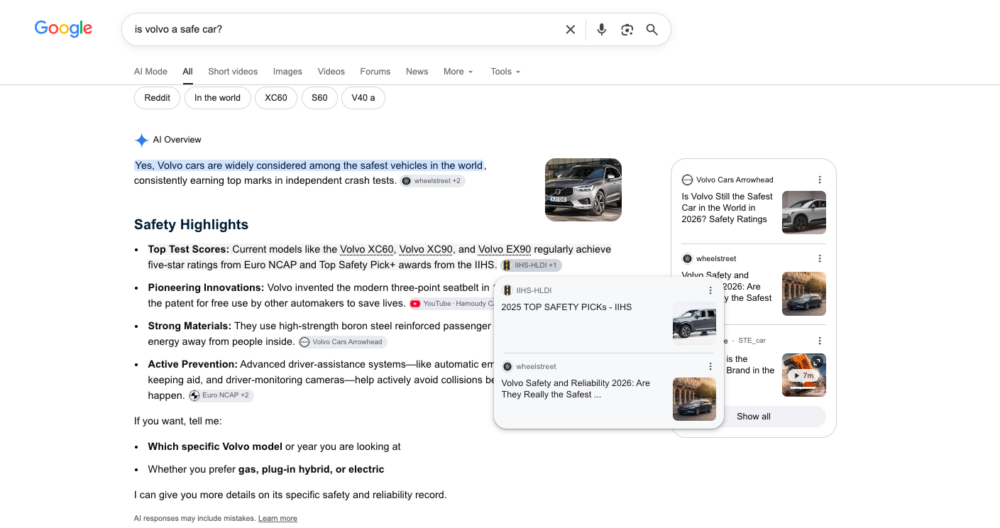
Volvo and Safety: How Validation Becomes Reputation
Think about Volvo and safety.
Volvo has spent decades associating its brand with safety.
If Volvo were the only source making that connection, it would simply be positioning.
But independent organisations repeatedly test the products against safety criteria that Volvo does not control.
For example, the Insurance Institute for Highway Safety awarded the 2025–26 Volvo XC90 and EX90 its Top Safety Pick+ designation under its 2025 criteria.
Euro NCAP independently assessed the EX90 as well. Its evaluation found good protection across several crash scenarios and awarded maximum points in the side-barrier and side-pole portion of the assessment.
Volvo can say safety is central to its brand. But independent testing repeatedly giving people reasons to associate Volvo with safety is something different.
The claim moves beyond self-description.
It becomes externally validated. And when that association is reinforced repeatedly over time, it becomes reputation.
This is the distinction brands should care about when thinking about AI visibility too.
Not simply: How many places mention us?
But: How many independent sources give the information ecosystem a reason to reach the same conclusion about us?
Why Third-Party Consensus Can Still Be Misleading
This does not mean every external mention is automatically validation.
Third-party signals can also be manipulated. Paid reviews, affiliate roundups, coordinated community seeding, sponsored content, thin comparison pages and synthetic content can all create the appearance of independent consensus.
So the distinction is not:
Owned source = bad. Third-party source = good.
The better question is whether the signal is:
- independent,
- credible,
- specific,
- and grounded in something observable.
Ten websites repeating the same marketing claim do not necessarily provide ten pieces of evidence.
They may provide one claim ten times. That difference is super important for AI visibility.
Why Brands Cannot Self-Declare Their Way Into Reputation
Your website matters a lot. It should clearly explain what you do, who you serve, why your product is different and what evidence supports those claims.
SEO makes that information discoverable, understandable and retrievable.
But your website will always be your website.
You control the claims.
You control the examples.
You control the positioning.
That makes it a very good source for understanding what a company says about itself.
It is not enough on its own to establish what the market believes about the company.
For that, we need sources the company does not fully control.
This is the distinction I keep coming back to when AI visibility is treated as an extension of SEO.
SEO can help AI systems find evidence. It cannot manufacture independent validation.
And this is consistent with something I have seen in my own data. In an analysis of Google Generative AI visibility, the strongest visibility concentrated around the product and topic for which the company already had its clearest external brand association and reputation. Organic performance mattered, but ranking position alone did not explain where that visibility concentrated.
That does not prove reputation caused the AI visibility. But it does give us a much more interesting place to investigate than another round of page-level optimisation.
Why Distribution Without Validation Is Just Louder Repetition
“Be everywhere” is becoming another piece of AI visibility advice.
But distribution without validation creates a louder version of the original claim.
The sequence is important in this context.
Produce an idea. Prove it. Get others to validate it. Then distribute it until the market starts repeating it for you.
That is very different from publishing the same positioning statement in fifty places and calling the resulting repetition authority.
The objective is not to make a claim ubiquitous but to create something credible enough that other people choose to repeat it.
That could be proprietary research.
A product capability competitors genuinely cannot reproduce.
A measurable customer result.
A benchmark.
A strong point of view that survives scrutiny.
An experience customers independently describe in similar ways.
Once independent people and sources start reinforcing the association, distribution becomes amplification rather than fabrication.
Why Brand Reputation Matters for AI Visibility
This is why I keep separating SEO from AI visibility.
SEO deals extremely well with discoverability, structure, retrieval and information architecture.
But when we start asking:
- Why is this brand repeatedly recommended?
- Why is this company associated with this category?
- Why does one company keep appearing in conversations it did not create?
- Why do independent sources describe the brand in similar ways?
We have moved beyond page optimisation. We are talking about reputation.
Reputation is the accumulated result of what a company says, what it actually does and, crucially, what other people conclude from those things.
AI systems are turning that accumulated external perception into something brands can suddenly see reflected back at them.
The Goal Is Not Consensus. It Is Validated Consensus.
You want the market to repeat your positioning. But you want it to repeat it because reality keeps confirming it, not because you managed to publish the claim often enough.
That is a much harder marketing problem.
It requires product, brand, PR, community, research, customers and, yes, SEO to reinforce the same truth from different directions.
There is no prompt trick for that.
There is no schema property for it.
And there is no AI visibility platform that can manufacture it for you.
You have to give people something worth validating first. Then make sure the evidence is impossible to miss.
If your brand is showing up inconsistently in AI systems, or you’re not sure whether the problem is SEO, reputation, or lack of external validation, I can help you diagnose what’s missing and where to focus next. Let’s talk.
Keep reading
Related articles

Higher Organic Rankings Do Not Increase Google AI Visibility
A proprietary analysis of Google Search Console data comparing organic rankings with visibility in AI Overviews and AI Mode.

How to Calculate Reddit Marketing ROI (When There’s No Clean Number)
There's no clean ROI number for Reddit marketing. Here's the test-fail-win methodology I actually use and when to walk away

The AI Attribution Lie Nobody Wants to Talk About
Onboarding surveys showing AI as a top discovery channel are not proof of AI-driven leads. Here's the behavioural bias making your attribution data unreliable.