September 7, 2026
Higher Organic Rankings Do Not Increase Google AI Visibility

A proprietary analysis of Google Search Console data comparing organic rankings with visibility in AI Overviews and AI Mode.
On June 3, 2026, Google introduced dedicated Generative AI performance reports in Search Console, giving site owners a separate view of how often their pages appear in generative Search features such as AI Overviews and AI Mode. For the first time, we have dedicated first-party Google reporting that lets us investigate generative Search visibility at page level rather than relying entirely on third-party visibility tools, inferred traffic patterns or server log analysis. The data is still limited. Search Console does not expose the queries behind individual Generative AI page impressions, but there is enough to investigate a question I have been particularly interested in:
Do stronger organic rankings translate into better visibility in Google’s AI Overviews and AI Mode?
To explore that, I analysed Google Search Console’s Generative AI data for a large travel website operating across both B2B and B2C.
During June and July 2026, the property generated roughly 8 million organic Search impressions and 1 million Google Generative AI impressions.
I compared the 1,000 URLs available in the Generative AI report with the 1,000 URLs available in the organic Search performance report. 891 URLs appeared in both datasets.
The data showed a clear relationship between organic performance and Google AI visibility, but not a linear one.
Among the most AI-visible pages:
- all of the top 100 URLs by Google AI impressions also appeared in the top-1,000 organic Search export;
- 65% of the top 20 AI-visible URLs averaged an organic position within the top 10;
- 57% of the top 100 averaged a position within the top 10;
- some of the most AI-visible URLs ranked well outside page one, including one top-20 URL with an average organic position above 35.
The distribution of AI impressions was even more interesting.
Within the 891 matched URLs, roughly 69% of Google AI impressions came from pages averaging positions 4–10, while another 23.5% came from pages averaging positions 11–20. Pages averaging positions 1–3 accounted for only a very small share.
That does not mean positions 4–10 are somehow better for AI visibility. The ranking groups contain different numbers of pages and a relatively small number of large URLs can materially affect the distribution.
What it does show is that Google AI visibility did not simply increase as average organic position improved.
And there was another pattern.
The strongest Google AI visibility was concentrated around the product and topic for which the company already had its clearest brand association and external reputation.
That matters because Google’s AI Overviews and AI Mode sit inside Google Search. A relationship with SEO should therefore be expected. But the data does not support a simple model in which ranking higher automatically makes a page more visible in generative Search.
This analysis is also specifically about Google’s generative Search experiences. It should not be extrapolated to mean that visibility across ChatGPT, Perplexity, Gemini and other AI systems is simply another branch of SEO.
For me, the more useful conclusion is:
Organic performance matters for Google AI visibility, but ranking position alone does not explain where that visibility concentrates. That is where page usefulness, brand-topic association and external reputation become much more interesting.
A note on scope: this analysis is based on one large travel website and on the data currently available in Google Search Console for AI Overviews and AI Mode. It should be read as an observed pattern within this dataset, not as a universal model of AI visibility or retrieval. I did not analyse server log files, so I am not attempting to reconstruct crawler behaviour or Google’s internal retrieval process. I am seeing similar patterns across other projects, particularly the disconnect between ranking position and AI visibility, but those observations are supporting context rather than evidence for the conclusions here.
Table of Contents
Google Search Console Data and Methodology

I used two page-level exports from Google Search Console:
- the 1,000 URLs available in the standard organic Search performance report;
- the 1,000 URLs available in the Google Generative AI performance report.
Both exports covered the same period, June to July 2026, for the same property.
At property level, the website generated roughly 8 million organic Search impressions and 1 million Google Generative AI impressions during that period.
I matched the two exports by URL. 891 URLs appeared in both datasets.
For those matched URLs, I compared:
- average organic position;
- organic impressions;
- organic clicks;
- Google AI impressions.
Throughout this analysis, Google AI visibility refers to page-level impressions reported in Search Console’s Generative AI report: instances where a link to the website appeared within Google’s generative Search experiences.
The report tells me that a URL received visibility within Google’s generative Search experiences. It does not tell me which part of the page informed the generated response, whether the page supported a specific statement, or which query triggered that impression.
There is another important limitation here.
Search Console exposes up to 1,000 rows in each of these reports. The matched dataset is therefore the intersection of the URLs available in those two exports, not a complete census of every organically visible page on the website.
That matters when interpreting the results. The analysis is useful for comparing the pages with meaningful visibility in both datasets, but it should not be read as a complete model of the relationship between organic rankings and Google AI visibility across every URL on the site.
Google also does not expose the query responsible for each Generative AI page impression, so I cannot say:
this page ranked third for this query and was then surfaced in the AI experience for that same query.
The findings should therefore be read as page-level patterns within the available data, not evidence of query-level causation or a reverse-engineered model of how Google selects sources for generative Search.
Organic Rankings and Google AI Visibility
The clearest relationship was also the least surprising: pages receiving the greatest Google AI visibility were generally already meaningful organic performers.
All of the top 20 and top 100 URLs by Google AI impressions were present in the top-1,000 organic Search export.
But their ranking positions tell a more nuanced story.
Among the top 20 pages by Google AI impressions:
- 13 of 20, or 65%, had an average organic position within the top 10;
- the median organic position was 8.57.
Among the top 100:
- 57% averaged a position within the top 10;
- the median organic position was 9.05.
So strong organic performance was clearly common among the most AI-visible pages.
But page-one rankings were neither universal nor sufficient to explain the distribution.
Several of the most AI-visible pages averaged positions outside the top 10, including pages around positions 12, 14 and 16. One of the top 20 AI-visible URLs had an average organic position above 35.
Looking across all 891 matched URLs, the same non-linear pattern became even clearer. Roughly 69.2% of Google AI impressions came from pages averaging positions 4–10, while 23.5% came from positions 11–20 and 6.9% from positions 21+. Pages averaging positions 1–3 accounted for just 0.35% of AI impressions in the matched dataset. That does not mean positions 4–10 are inherently better for AI visibility. The ranking bands contain different numbers of URLs, and a small number of high-volume pages can materially shape the distribution.
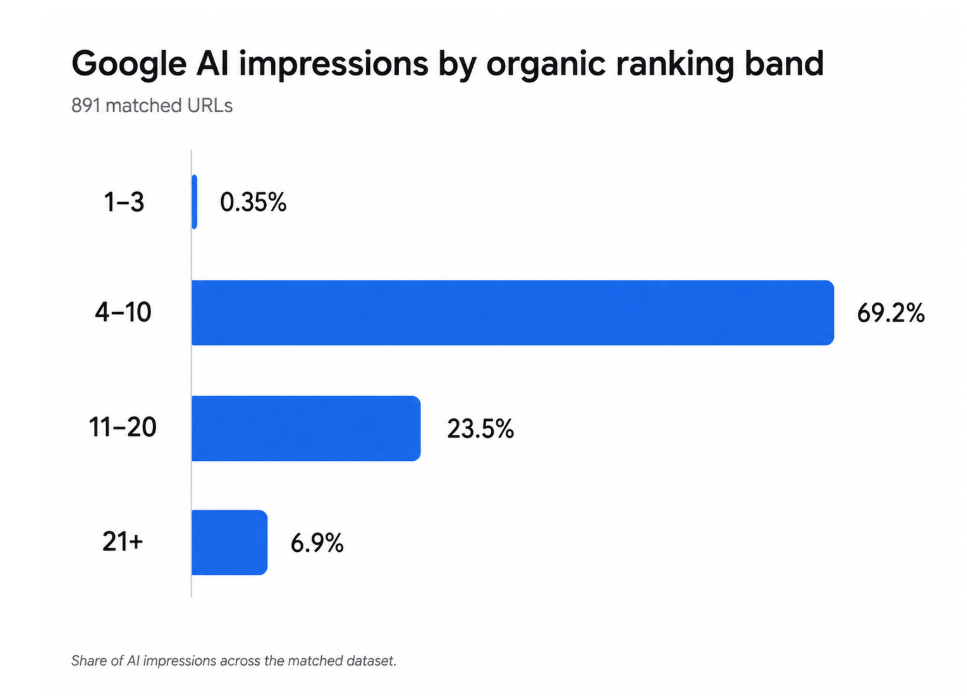
There was no simple pattern in which the URLs ranking closest to position one automatically received the greatest AI visibility. That is where the relationship becomes more interesting.
Does Ranking Higher Increase AI Visibility?
If average organic position directly determined Google AI visibility, we would expect AI impressions to rise fairly consistently as rankings improved.
That is not what the matched data shows.
Across the 891 URLs:
- pages averaging positions 1–3 accounted for about 0.35% of AI impressions;
- positions 4–10 accounted for about 69.2%;
- positions 11–20 accounted for about 23.5%;
- positions 21+ accounted for about 6.9%.
This does not mean positions 4–10 are somehow optimal for AI visibility. The groups differ substantially in size, and the dataset contains a small number of very large pages that account for a significant share of impressions.
This is an impression distribution, not an AI citation rate by ranking position.
What it does show is that AI visibility was not distributed according to a simple “higher organic position equals more AI exposure” pattern.
Even among the pages receiving the most AI visibility, pages ranking outside the top 10 could substantially outperform pages with stronger average positions.
So I would avoid treating page-one rankings as an AI eligibility requirement or suggesting that moving from position six to position two should automatically increase generative visibility.
The more defensible conclusion is:
Organic performance and Google AI visibility were clearly connected in this dataset, but average ranking position alone did not explain where AI visibility concentrated.
That leaves a much more useful question:
What was separating pages with similar or even stronger organic performance but very different levels of Google AI visibility?
Brand-Topic Association and AI Visibility
Average organic position could not explain the full distribution of Google AI visibility.
That does not mean rankings stopped mattering. The most AI-visible URLs were still established organic performers, and all of the top 100 AI-visible pages appeared in the top-1,000 organic Search export.
But their positions varied considerably.
Some of the most AI-visible pages averaged positions outside the top 10, while other pages with stronger organic positions received far less generative visibility.
That made the next pattern more interesting.
The pages receiving the greatest Google AI visibility disproportionately belonged to the product category for which the company was already most recognised.
This was also the part of the business with the strongest footprint across:
- the company’s own content;
- organic search;
- third-party coverage;
- industry references;
- external mentions;
- and wider online discussion.
The company was not merely publishing pages about this topic.
It was repeatedly being associated with it.
That same product category was also heavily represented among the pages receiving the greatest Google Generative AI visibility.
That association was not something I inferred from the Search Console report. I already knew it from separate work on the company’s external footprint: where it was mentioned, which products attracted third-party coverage, and which topics the wider web repeatedly connected with the brand.
So when the same product category dominated the Generative AI report, the overlap was hard to ignore.
I would not claim that brand-topic association caused the AI visibility. I have not quantified entity strength and tested it against AI impressions. But it is a pattern worth paying attention to.
It is consistent with what we would expect a strong brand-topic relationship to look like in practice.
A company becomes repeatedly connected with a product, service, category, problem or use case.
That relationship gets reinforced through owned content, rankings, internal links, external mentions, reviews, editorial coverage and references elsewhere on the web.
Eventually, the relationship exists beyond any individual page.
The page helps establish what that page is about.
The wider footprint provides evidence of what the company itself is repeatedly associated with.
This is where Google AI visibility starts to look less like a question that can be explained through page-level rankings alone and more like a brand problem.
SEO can strengthen the content a company owns and make that content easier to discover, understand and retrieve.
But it cannot, on its own, manufacture the wider association between a company and a topic.
That association develops through repetition and corroboration: what the company publishes, what it ranks for, what other people write about it, where it is mentioned, how its products are discussed, and which problems or categories it is consistently connected with across the web.
This is also different from topical authority as we usually discuss it in SEO.
A strong content cluster can establish depth around a subject on a website. Brand-topic association extends beyond the website. The company itself becomes connected with the subject across a much wider information ecosystem.
That distinction is important.
- Adding an FAQ does not create that relationship.
- Changing every heading into a question does not create that relationship.
- Publishing another 2,000 words does not create that relationship.
Those things may improve a page. They do not manufacture what a company is known for.
And that is the part of the pattern I find most interesting here.
Measuring AI Overperformance
Sorting the Generative AI report by total impressions tells you which pages receive the most visibility. It does not necessarily tell you why.
Some of the largest pages were already major organic performers and central to established parts of the website.
The more revealing pages were the ones whose AI visibility looked unusually large or small relative to their organic footprint.
To identify those pages, I created a simple AI overperformance index.
For each of the 891 URLs present in both exports, I calculated:
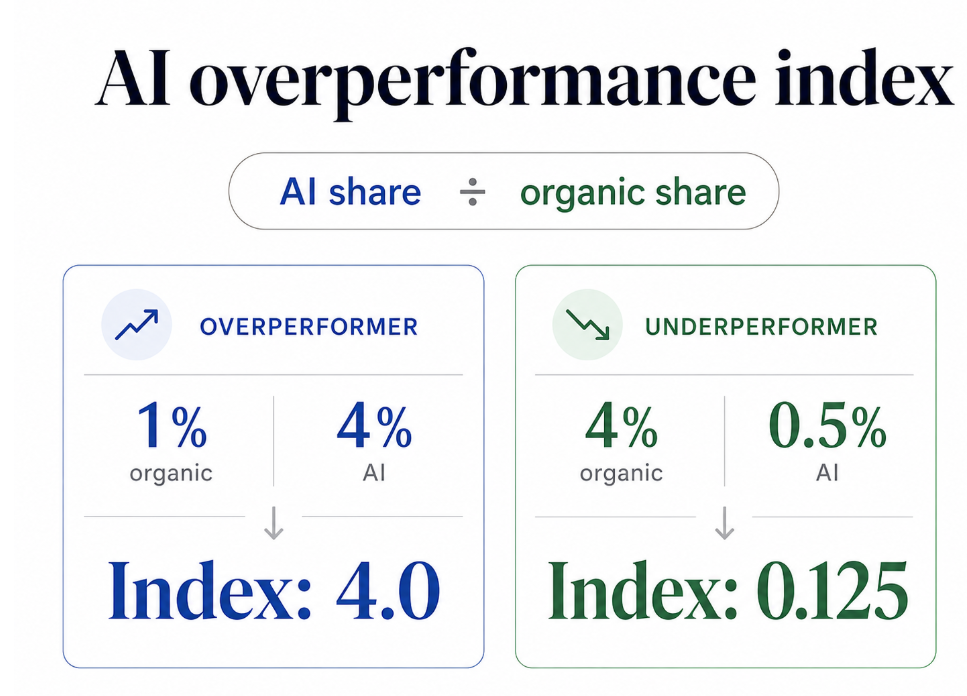
Page share of AI impressions within the matched dataset ÷ page share of organic impressions within the same matched dataset
In other words:
AI share = page AI impressions ÷ total AI impressions across the 891 matched URLs
and:
Organic share = page organic impressions ÷ total organic impressions across those same 891 URLs
The index is then:
AI share ÷ organic share
An index above 1 means a page accounts for a larger share of AI visibility than of organic visibility within the matched dataset.
An index below 1 means the opposite.
Imagine a page accounts for:
- 1% of organic impressions;
- 4% of AI impressions.
Its index is 4.
Now take a page accounting for:
- 4% of organic impressions;
- 0.5% of AI impressions.
Its index is 0.125.
The first page is substantially overrepresented in AI visibility relative to its organic footprint.
The second is substantially underrepresented.
The calculation does not explain why. That is not its purpose. Its value is diagnostic. It gives us a way to move beyond the biggest URLs and identify pages whose AI visibility behaves differently from their organic scale.
I also excluded very low-volume pages from the qualitative comparison.
Small denominators can produce dramatic-looking ratios without representing meaningful visibility, so I focused on pages with at least 100 Google AI impressions and 1,000 organic impressions.
That left 435 URLs to investigate.
The thresholds are not a Google benchmark or a universal definition of an overperformer. They are simply a practical way to reduce low-volume noise in this dataset.
Instead of asking:
Which pages have the most AI impressions?
we can ask:
Which pages receive substantially more or less AI visibility than their organic footprint would suggest, and what do those pages have in common?
What AI Overperforming Pages Had in Common
The strongest overperformers were not one specific page type.
They included practical guides, destination and programme pages, product explanations and pages addressing specific questions or use cases.
Some also ranked outside the organic top 10.
That matters because it reinforces the broader finding: high AI visibility was not simply a reward for having the strongest average organic position.
What many of the overperformers did share was more basic:
they contained information that could actually be useful inside an answer.
They tended to explain a problem clearly, show how something worked, answer a specific need or provide information someone could use to make a decision or complete a task.
The useful information was also relatively easy to locate.
That does not mean Google rewards short paragraphs, question headings or FAQ blocks.
Those are presentation choices.
The underlying observation is much simpler. A product claim is marketing. A clear explanation of how something works, what its limitations are and what someone needs to do next provides much more usable information.
Likewise, generic advice is available everywhere. Firsthand knowledge, practical processes, original information, real limitations, platform-specific detail and expert explanation provide something more distinctive.
This is not a new “GEO content formula.” It is useful information organised well.
And that was often what the overperformers provided.
Importantly, I would still treat this as an observed characteristic rather than a proven selection factor.
The index identifies pages worth investigating. It does not tell us why Google surfaced them more frequently.
When Low AI Visibility Is Not a Problem
The underperformers are just as useful. Some pages generated very substantial organic visibility while accounting for a much smaller share of Google AI impressions.
And many of them ranked well.
The low-index group included destination pages, navigational and company pages, programme pages and content with strong organic demand but comparatively limited generative visibility.
That does not automatically make those pages weaker.
Intent matters. Not every search benefits from a generated answer. Someone navigating to a company or account page may simply want the website. Someone comparing destinations may want to browse. Someone ready to complete an action may not need an AI response sitting between the search and the destination.
Not every successful organic search experience needs to become a generative one.
That becomes increasingly important as Google AI impressions make their way into reporting dashboards.
Low AI visibility will inevitably start being interpreted as a problem that needs fixing.
Sometimes it may indicate an opportunity.
Sometimes it may simply reflect what the page is designed to do.
A destination or programme page should not automatically be benchmarked against an explanatory guide.
A navigational page should not be expected to behave like informational content.
And a page should not be considered weaker simply because its organic visibility does not translate proportionally into Google AI impressions.
That is another reason the overperformance index is useful as a diagnostic, not a score.
How to Use Google AI Visibility Data for SEO
Start with fundamental SEO and content-quality checks. Separate pages according to purpose and intent.
Then compare genuinely similar pages. Within those groups, look at:
- whether the page actually satisfies the query or user need;
- whether the information is accurate, useful and sufficiently detailed;
- whether important information is easy to find;
- whether likely follow-up needs are covered;
- whether the page is properly connected to the wider topic cluster;
- whether the content remains current;
- and whether there are obvious gaps in relevance, structure, internal linking or information quality.
These are not new GEO techniques. They are the same kinds of questions good SEO teams should already be asking.
The corrected data makes that distinction even more important.
A page does not appear to gain predictable amounts of Google AI visibility simply by moving higher through the organic rankings.
That means looking at an underperforming page and immediately asking how to “optimise it for AI” is the wrong starting point.
First establish whether there is an SEO, content or intent problem at all.
Then look beyond the page:
- how strongly the company is associated with the topic;
- what external validation exists;
- whether that association is reinforced consistently elsewhere;
- and whether AI visibility is even a meaningful outcome for that particular type of page.
The goal is not to discover the magical heading structure that gets Google to cite you. It is to understand where Google AI visibility diverges from organic visibility, and then investigate what distinguishes those pages, topics and brand relationships.
That makes the data useful as a diagnostic rather than another optimisation score to chase.
AI Visibility, SEO and Brand Reputation
This is where the analysis connects with something I have argued before: AI visibility is not simply SEO under a different name.
For Google’s generative Search experiences, SEO is clearly part of the system. The pages receiving the greatest Google AI visibility were established enough organically to appear in the top-1,000 Search export.
But neither page-one status nor incremental improvements in average ranking position explained the full distribution of that visibility.
Some highly AI-visible pages ranked outside the top 10.
Other pages with stronger organic positions received comparatively little AI visibility.
So SEO matters, but the relationship is not simply:
rank higher → receive more AI visibility.
At the same time, the strongest concentration of Google AI visibility appeared around the part of the business for which the company also had the clearest wider brand association and external reputation.
That distinction matters:
- SEO helps make what a company publishes discoverable, understandable and retrievable.
- Brand-topic association reflects what the company is repeatedly connected with across the wider information ecosystem.
- Reputation provides independent evidence that those associations are credible beyond the company’s own claims.
These things overlap, but they are not interchangeable.
A company can optimise a page about a topic. It is much harder to optimise its way into being known for that topic.
This dataset cannot prove that stronger brand-topic association caused Google to surface these pages more often.
Nor can it tell us how Google weights brand, reputation, page usefulness or any other individual signal.
What it can show is that average organic ranking position alone is insufficient to explain the pattern.
And once that becomes clear, treating AI visibility primarily as a page-optimisation problem starts to look incomplete.
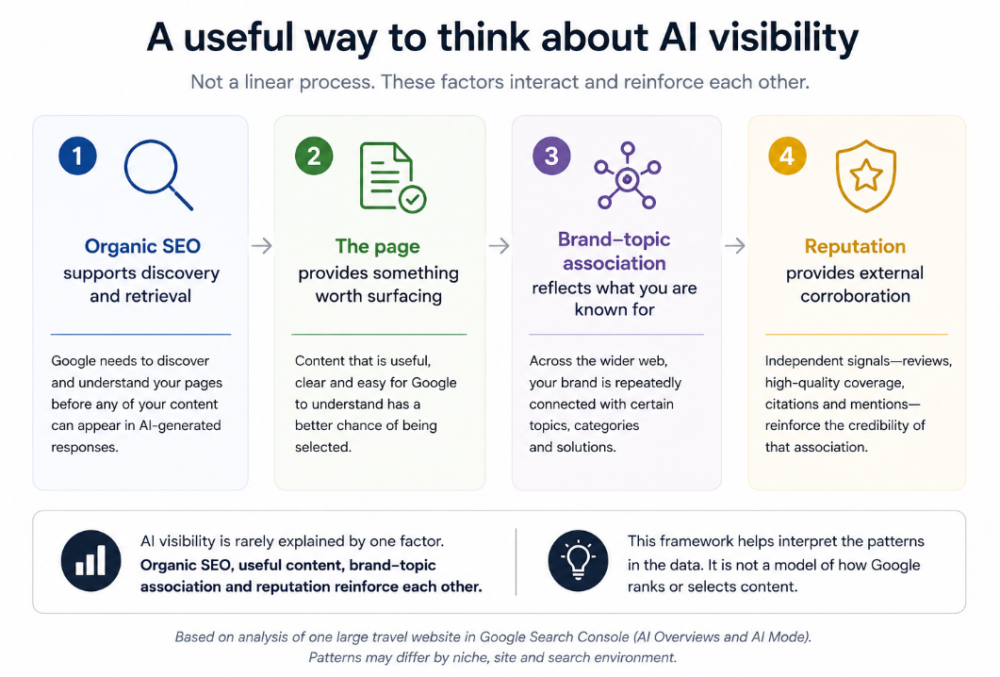
A useful way to think about it is:
Organic SEO builds the retrieval foundation.
The page provides something worth selecting.
Brand-topic association shapes what the company is known for.
Reputation strengthens the credibility of that association.
This is a conceptual framework for interpreting the pattern, not a claim that the data has proved four stages in Google’s retrieval system.
Page structure matters. Clear writing matters. Useful information matters. But those things have always mattered.
They also cannot, on their own, explain why one company becomes repeatedly associated with a subject across search engines, AI systems and the wider web.
That is where AI visibility can no longer be understood through SEO alone. Brand association and reputation become part of the picture.
What Google Rankings Can and Cannot Explain
This analysis is based on one large website in one specific sector, so I cannot treat the findings as universal.
Since completing it, I have applied the same methodology to four other businesses in the travel sector. I am not using those datasets as evidence here, but the same broad tension keeps appearing: organic strength matters, ranking position alone does not explain Google Generative AI visibility, and visibility often concentrates around areas where the brand already has a strong association.
That does not make it a universal rule but it does make the pattern worth investigating further.
What this dataset does show is that organic performance is far from irrelevant. Quite the opposite.
The pages receiving the greatest Google AI visibility were already meaningful organic performers. But the relationship was not linear. Pages outside the top 10 could receive substantial generative visibility, while stronger-ranking pages sometimes received far less.
At the same time, visibility concentrated around useful pages, established topic ecosystems and the part of the business with the strongest wider brand association.
That does not tell us exactly how Google selects what to surface in AI Overviews or AI Mode.
But it does make one idea harder to defend: that AI visibility can be reduced to a new layer of page-level optimisation. If rankings alone explained it, the distribution should have been more predictable. If headings, FAQs, schema or “citation-ready” paragraphs explained it, we would still be looking for the answer entirely on the page.
The pattern is broader than that.
Google’s generative Search visibility was strongest where organic performance, useful content, established brand association and external reputation appeared to reinforce one another.
So the more interesting question is no longer: How do we optimise this page for AI?
It is: What does the wider web already give Google reason to associate us with, and is that the association we actually want to own?
And that is exactly why I think AI visibility is a brand issue.
I help companies understand where SEO ends and broader AI visibility begins: from diagnosing how organic performance translates into generative Search visibility to building the brand, content and external signals that strengthen that presence. If you want to understand what your own data is telling you, and where the real opportunities are, let’s talk.
Keep reading
Related articles

Why AI Visibility Depends on Brand Validation, Not Consensus
AI visibility is not built through repetition alone. Learn why brand validation, third-party evidence, and reputation are more important than manufactured consensus.

How to Calculate Reddit Marketing ROI (When There’s No Clean Number)
There's no clean ROI number for Reddit marketing. Here's the test-fail-win methodology I actually use and when to walk away

The AI Attribution Lie Nobody Wants to Talk About
Onboarding surveys showing AI as a top discovery channel are not proof of AI-driven leads. Here's the behavioural bias making your attribution data unreliable.